I spent four months building PermitPipeline. Then Google stopped showing it.
On August 4, Google showed pages from my website a little over 3,000 times. On August 19, it showed them 38 times.
Nothing broke. The site loads. The pages are still in Google’s index, and Google’s own tools fetch them and report everything clean. No manual action appeared in Search Console, no rule was named, no email arrived. One of the largest machines on earth quietly, and without a word of explanation, nearly stopped surfacing my company, six weeks after strangers first started trying the product.
I run the site alone, so I got to play detective alone. Over the next several days, I worked through what had happened. The timing overlapped with a Google spam update and a major site expansion I had shipped four days before the update began, and I cannot prove that either caused the collapse. The ending is not the one I wanted. But I think the case file is worth reading, because what happened to me is built into how the internet works now, and it can happen to anyone who publishes data.
Start with why the site exists at all.
A cabinet shop in Brooklyn
I spent 20 years in construction, from carpenter to estimator to project manager on high end residential work. I built PermitPipeline on a simple idea from that career: the building permit is the earliest public record that a project is real, and cleaned up, permits make good project leads. Permit data is a mess. Every city publishes it differently, names are inconsistent, one project scatters across dozens of filings. So I cleaned it, and it worked. People were finding leads.
Then a cabinet shop in Brooklyn changed the product with one piece of feedback. They did not just want the projects. They wanted to know about the architects behind them, because the architect is who sends a cabinet shop its next ten jobs.
That was the light bulb. I already had that information. It was sitting in the permits, waiting for someone to connect it. So I built a directory of the firms doing the work: which firms work together, how much permitted activity appears in the public filings, what kind of work, and where. An architect’s page shows their projects, the contractors they team with, their permitted activity over time. I published all of it for free.
Then, at the end of June, the cabinet shop signed up for a trial and entered a credit card. It was the first time a stranger had trusted the product enough to do that. Months of lonely, sleep deprived work that had consumed family time suddenly felt like it had been pointing somewhere.
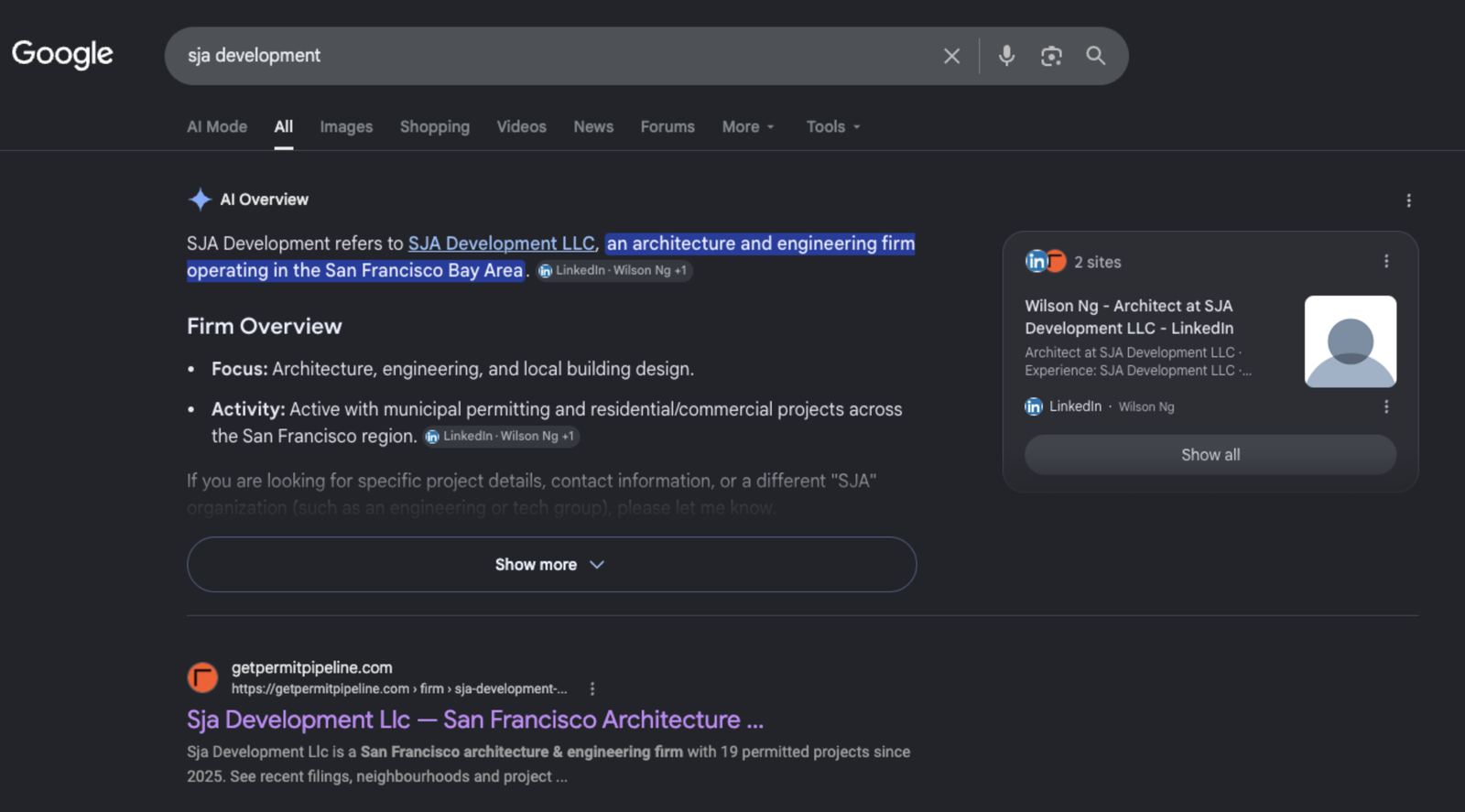
The pages began ranking too. Several reached number one for real searches. On August 3, a PermitPipeline profile ranked number one when you searched a working San Francisco architecture firm by name, and I kept checking it because I could not quite believe it. I even saw PermitPipeline cited as a source in a Google AI overview, its logo sitting right there in the sources panel. Bing sent visitors. ChatGPT sent visitors.
Two weeks later, the chart fell over.
The investigation
When most of your visibility disappears in a week, you work through the suspects in order.
The first suspect is a manual action, a human at Google flagging your site. I checked. Nothing. The second is a security problem, a hack quietly poisoning your pages. Nothing. The third is deindexing, Google throwing the pages out of its library. Wrong again: every page I inspected was still marked indexed, still crawlable, still clean.
The fourth suspect was the obvious one, and I believed in it for a while: the directory itself. I had published thousands of firm pages built from one template. Maybe Google had judged the new pages thin and cut them loose.
Then I found the clue that broke that theory. My articles had collapsed too. The written guides, the ones I authored myself with no template involved, fell from about 250 impressions a day to 4, on the same days the firm pages fell. Firms searched by their own names went from 849 surfacing in a week to 92. And here is the strangest detail in the whole case file: the pages that do still appear rank as well as ever. That same firm profile still sits at number one on the rare occasions Google serves it at all. Google did not demote my pages. It mostly stopped dealing them into the game. The pattern appeared sitewide, not limited to the new firm profiles.
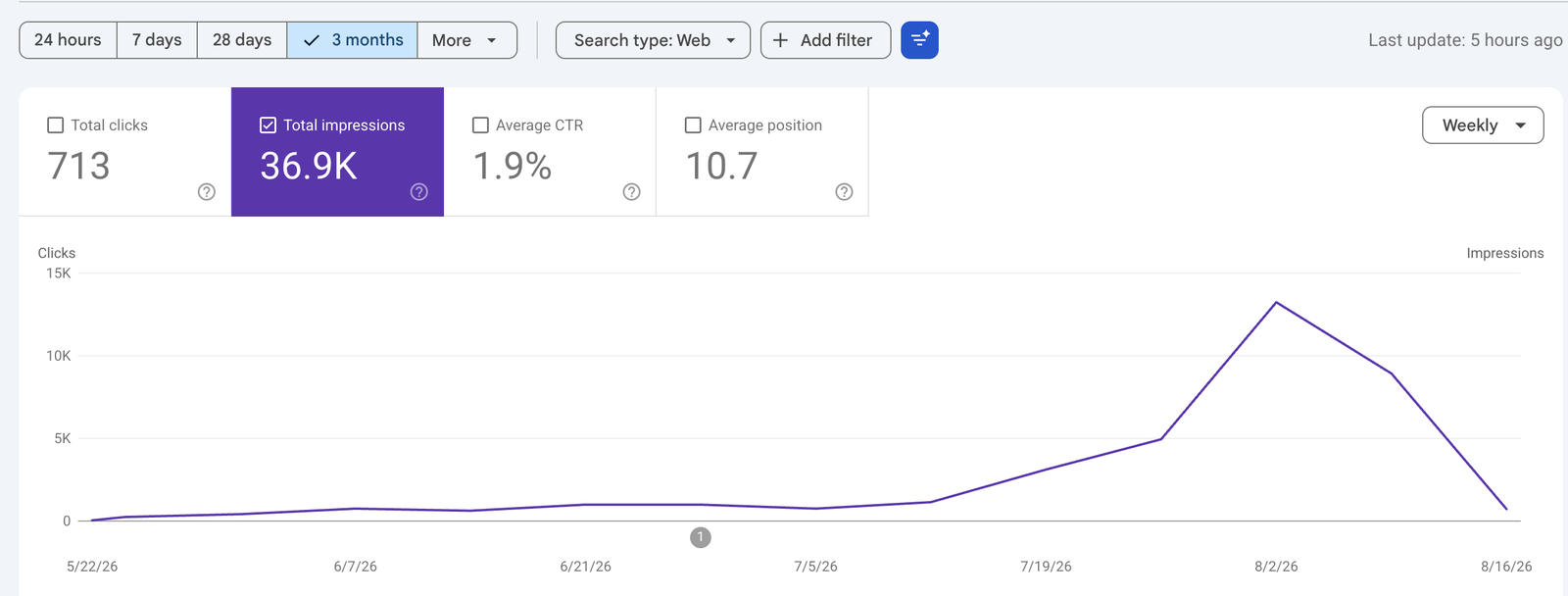
That narrowed the timeline to a question: what could hit an entire domain in the middle of August? The timing raised an obvious possibility. My slide began around August 15. On August 18, Google began rolling out a spam update. I cannot prove the update caused the collapse, and the decline had already started before the official rollout began. But the overlap forced me to look at my own site the way a spam system might.
Which brings me to my confession.
The mistake
On August 14, I doubled the size of my website in one day. I added about 2,900 San Francisco firm pages in a single publish, and I remember being proud of it. Two cities, thousands of firms, the directory finally at scale.
From the outside, I had built a pattern an automated system might scrutinize: a young domain, thousands of similarly structured pages, and a site that doubled overnight. But these pages were not created to capture searches. They existed because a cabinet shop asked for the information, and they connect permit records in ways the original sources do not. My mistake was launching at that scale before every page, and the domain around them, carried enough evidence of that usefulness.
Silicon Valley’s favorite advice is to move fast and break things. I moved fast and I broke things. Whether those mistakes contributed to the collapse or not, they were mine to fix.
There were real defects too, and I owe them to the record. A bad code change briefly shipped worse titles and conflicting canonical tags. Some statistics were computed from the wrong group of firms. A handful of pages had no business being indexed at all. I found every one of those problems and fixed them.
The experiment that has not worked yet
Then I ran the test that taught me the most. I picked 39 repaired pages and asked Google to look at them again. It recrawled 37, most on the same day I asked. As of August 23, none had recovered. Recrawling alone had not produced an immediate change. Google's own guidance says its automated systems can take months to recognize sustained improvement after a spam related change.
That killed the most comforting theory, that Google simply had not seen my fixes yet. Google has recrawled the repaired pages. Its search visibility has not, so far, recovered. Recrawling does not necessarily mean Google’s ranking systems have fully reevaluated the site. The update finished rolling out on August 21 with my site still suppressed, and whatever re-evaluation comes next runs on a clock I cannot see, in a courtroom I cannot enter, over weeks or months.
Meanwhile Bing still sends people. ChatGPT still sends people. The same site, read by different machines, gets a different verdict.
What I do with that
Four months ago this product was an idea. Today its permit data covers four cities, real businesses have signed up to try it, and it is honestly better than it was before the collapse, because the collapse forced a level of quality control I might have deferred for a year. The directory is still free, and it stays free, because a cabinet shop in Brooklyn was right about what people actually need.
And the same cleaned data can do more than surface individual opportunities. In aggregate, it can show where the preconstruction pipeline is expanding, slowing, or changing, city by city. The first PermitPipeline Preconstruction Activity Index is now live. So is the rest of the plan: every permit in New York, more cities, and eventually every major construction market in the country.
I am not asking anyone to manufacture backlinks or reverse an algorithm by hand. I am trying to answer a harder question: how does a small independent data company prove that a product built from public records is genuinely useful, to a system that has every statistical reason to assume it is not?
If this overlaps with your work
There are four groups of people who could actually move this story, and each one costs a few minutes.
If PermitPipeline’s data is useful in something you publish, cite it as you would any original data source. That is all. Not a favor, just normal attribution.
If you have brought a site back from a scaled content demotion, I want to compare notes. What changed, how long it took, what turned out to matter. Email me.
If you work on search quality anywhere, I am not asking you to pull a lever. I am asking what evidence would convince you, so I can go build that evidence.
And if you know a cabinet shop, an architect, a builder who could use free permit data, send them over. The visitors Google no longer sends have to come from somewhere, and right now that somewhere is people.
Google turned off one distribution channel. It did not turn off the company.
About the author: Josh Steinman is the founder of PermitPipeline. He earned an economics degree from Princeton and went to work as a carpenter, then spent 20 years in construction working his way up to project manager and owner’s representative on high end residential work, picking up a construction management certificate and an MBA with honors from Berkeley Haas, focused on real estate. He was a U.S. junior world champion rower and still races. More at getpermitpipeline.com/about/josh-steinman.